
Kits and Colvin

Took a beautiful walk with friends along the Colvin Run Trail, starting from Colvin Mill, at 10017 Colvin Run Road in Great Falls, Virginia. The mill is nicely situated as a trailhead, providing plenty of free parking, restrooms and drinking fountains and, during operating hours, a general store and tours of the historic mill itself. (You can even buy several kinds of flour ground in the mill if you’re handy enough in the kitchen to do anything with it.)
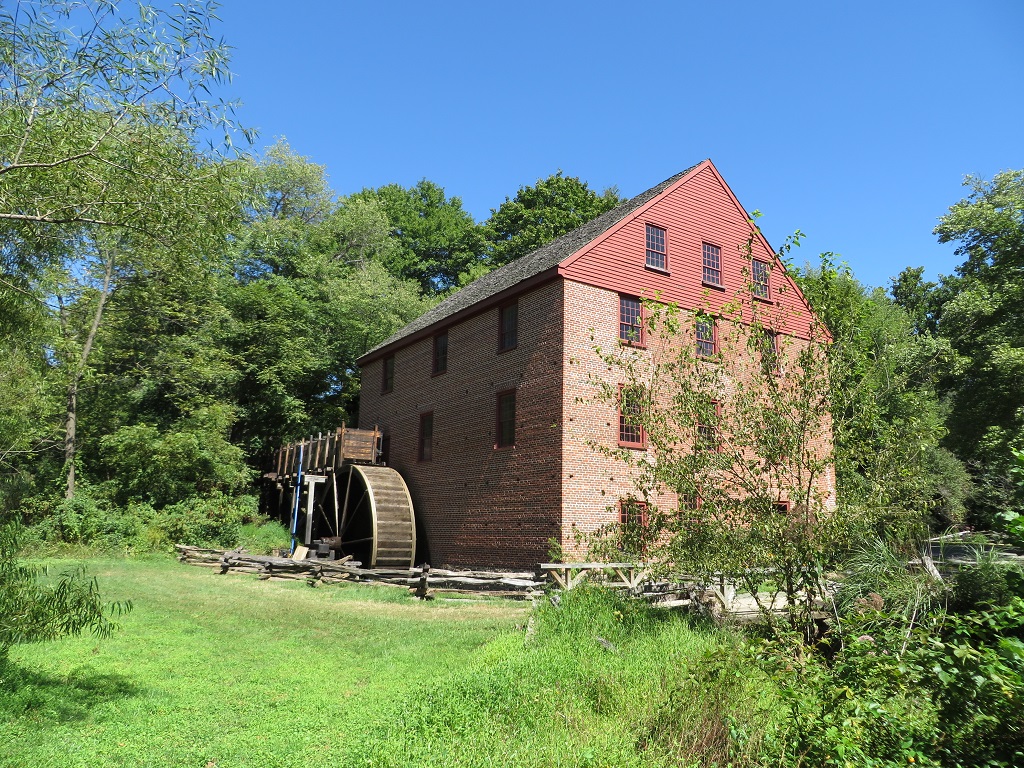
 From the mill you have two options for a hike, both pleasant:

  1. You can walk east, along Difficult Run Trail, which meanders alongside the stream of the same name until it empties into the Potomac River about 4 miles to the east, or
  2. You can walk west along Colvin Run Trail, which follows Colvin Run upstream almost 2 miles to Lake Fairfax Park

We took the second option today, and added a walk around Lake Fairfax before returning to Colvin Mill, for a total walk of about 5.5 miles. (You can add a lot more if you like, since Lake Fairfax Park is laced with trails. But you’ll need a copy of the Fairfax County Parks Authority trail map available in pdf format here. I made the mistake of going without during a Wednesday prehike and wound up walking 9 miles!)

So much for the “Colvin,” but what about the “Kits?” Fox kits, surely a pair of litter mates, were racing around playing in my backyard as I was getting ready to leave. I could only catch one for a few seconds, before the other leaped on it and they became tangled in a reddish blur before dashing off into the woods out of sight!

Posted in Hiking, Photography | Tagged , , , , , , , , , , | 2 Comments

North Marshall Mountain

Went snooping on North Marshall Mountain in the Shenandoah Mountains on Tuesday. A nice out-and-back 6.2-mile hike, easy to moderate difficulty except for the 1,000-foot elevation gain, and lots of solitude. (Except black bears – two adults and two cubs!) Unfortunately, there’s no ‘payoff’ vista at the summit due to foliage, so I’ll have to save this hike for group use until late Autumn or Winter, when the leaves have fallen.

A Google map of the route is here, but your mileage may vary, as they say (mine did). There is room for about 15 cars in Jenkins Gap parking lot, plus a few more at the adjacent overlook. The image used to make the topographical map is from Topoquest, here.

Posted in Hiking, Photography | Tagged , , , , , , , , , , | 3 Comments

Startled

Barred Owl

A barred owl at Pohick Bay Regional Park in Lorton, Virginia. It was apparently sleeping under a little footbridge in the woods and when I crossed, it came piling out of there in a flurry and perched only a few feet away, looking around to see what was going on. I’m not sure who was more startled — me, or the owl. It was early evening, almost sunset, so in another hour or so the owl would have been awake and hunting for a snack anyway.

Posted in Hiking, Photography | Tagged , , , , , , | 1 Comment

Resistance to Change

Here’s a timely article from the August edition of Token Publishing’s Coin News about the seeming inability of the US to migrate from the dollar bill to the dollar coin:

US CONGRESS has reopened the debate yet again on the future of the much-loved one dollar bill. The Government Accounting Office (GAO) reported last year that the replacement of $1 notes with $1 coins could potentially save $4.4 billion over 30 years. The overall net benefit was due solely to increased “seigniorage” (the difference between the cost of producing currency and their actual face value) and not to reduced production costs as first thought. Seigniorage in effect reduces government borrowing and interest costs, resulting in an overall financial gain for the government. However, for such a replacement to be successful, the $1 coin would have to be widely accepted and used by the general public and currently there is an overall lack of public acceptance of the low denomination coin. It is believed that efforts to increase the circulation and acceptance of the $1 coins [have] failed due in part to the continued circulation of the $1 note. Other countries, including the UK of course, have replaced low denomination notes with coins and the successful transition was due to an actual replacement of the denomination and not an attempt to run the two in tandem. Canada, likewise, phased out their low denomination note for coin and the Canadian Government reported a saving of some C$450 million over five years, so US paper dollar’s days could be numbered.

It is refreshing to see the issue laid out so simply, with examples of other countries’ successful transitions. Why can’t the US do what others have done? The reason cited (and widely advanced here in the US) is that the coin is unpopular with the American public because the dollar bill is still circulating, and the US government won’t remove the dollar bill from circulation because the dollar coin is unpopular. Sounds like an invented chicken-and-egg conundrum, if there ever was one. With a potential savings of $4.4 billion over 30 years in the balance, there has to be something more to it. There is:

Congress is once again considering a plan to eliminate the dollar bill and replace it with a coin.
U.S. Sen. Elizabeth Warren [D-MA] had a one-word answer for that one-dollar question Sunday: “No.”
Folding money is close to the heart of the Berkshires, where Crane & Co. has been making currency paper for the United States for more than a hundred years. The new high-tech $100 bill, printed on paper made in Dalton, finally makes its debut this October.
It’s also about jobs: the currency division alone employs 400 people.
“People don’t want the one-dollar coin … we tried that,” said Warren during a tour of Crane on Monday. “We tried it back in the ’70s and there’s a vault of one-dollar coins nobody wants.”

    • Tammy Daniels, “Warren Says Dollar Coin a No-Go During Crane Visit,” iBerkshires.com, 5 August 2013 | http://tinyurl.com/mdvgwsq

Ah, it’s about saving jobs, is it? Let’s see: considering the $4.4 billion saving over 30 years the GAO cited, that’s $3.67 million per employee, annually! Those must be some pretty highly skilled employees! As far as the 1970s dollars Warren cites, they didn’t circulate well because they were either too big and heavy (Eisenhower dollars) or were confusingly quarter-sized (Susan B. Anthony dollars). Just like today’s dollar coins, both suffered from continued circulation of dollar bills. With dollar bills still in circulation, any design was doomed to failure.

After 40 years of trying and several different designs, it becomes apparent that the problem does not lie with the dollar coin, but with the inability to stop production of the dollar bill. The iBerkshires article puts us onto the trail of the real reasons for that:

  • The Crane Paper Company has been in business since before the American Revolution, and has held the government contract to produce the paper used for US currency since 1879. I have nothing against the company, but they are dug in like a tick on a dog’s behind, as we used to say back on the farm. The resistance to change, of the coin variety anyway, is similarly entrenched.
  • The company is based in Massachusetts, which has long been a Democrat Party stronghold in Congress, with a lot of big-name political muscle (e.g. Kennedy, Kerry, etc.). Any attempt to cut paper currency production is politically Dead On Arrival, regardless of any savings involved.

I wish I could be as optimistic as Coin News in saying that the US paper dollar’s days are numbered, but as evidenced by Senator Warren’s simple “No,” there doesn’t seem to be any end in sight.

Notes

  1. “RESISTANCE TO CHANGE,” Coin News, Volume 50 No. 8, August 2013 | http://www.tokenpublishing.com/issue.asp?iid=360
  2. Tammy Daniels, “Warren Says Dollar Coin a No-Go During Crane Visit,” iBerkshires.com, 5 August 2013 | http://tinyurl.com/mdvgwsq
  3. Annalyn Kurtz, “Kill the dollar bill, for $1 coins instead?,” CNNMoney, 28 November 2012 | http://tinyurl.com/pafe3ra
  4. Crane Paper Company, Wikipedia | http://tinyurl.com/pz4vvj8
  5. Massachusetts members of Congress, govtrack.us | http://tinyurl.com/c3s6v4r
Posted in Coins, News | Tagged , , , , , | 2 Comments

Scott’s Run

On Saturday some friends and I went on a pleasant hike at Scott’s Run Nature Preserve, a small park in along the Potomac River in Fairfax County, Virginia. The park features the closest waterfall to Washington DC and a beautiful overlook of the Potomac. It’s laced with streambeds and trails through rugged terrain, but it’s almost impossible to get lost because the park is so small and is bounded on all sides by the Potomac, Scott’s Run, I-495, and Georgetown Pike. The park’s small size can be something of a drawback, though, since parking is very limited and some side excursions along secondary trails are needed to get in a hike much longer than a couple of miles.

The day was overcast and cool, with the occasional sprinkle and a slight breeze, making for comfy hiking. Fallen trees and slippery trails slowed the pace a bit and caused a lengthy detour. But this was a good thing, since we ended up hiking over 5 miles without doing a lot of backtracking.

I put together a Google map for general orientation to help hikers find the place and get an idea of the route, and the Dranesville District Park map at Topoquest is useful, but the topo map (pdf) at the Fairfax County website is the indispensable reference to the park’s tangle of trails.

A wonderful hike with a fun bunch of folks! Not everyone could make it Saturday due to the limited parking or schedule conflicts, so we’re going back again next weekend. And unlike dessert, I’m sure a second helping will taste just as good!

Posted in Hiking, Photography | Tagged , , , , , , | Comments Off on Scott’s Run

Unscripted

Some photos from a few walks during the last 2 weeks. I love the fun of a group hike, but it’s always when I’m blundering around on an unscripted hike, not worried about (and often) getting lost, that I run across the interesting subjects.

Posted in Hiking, Photography | Tagged , , , , | 4 Comments

Two rivers

Quite a busy weekend hiking at sites along two rivers in two different directions: south to the Occoquan River on Saturday, and then across the Potomac River to Kenilworth Aquatic Gardens on the Anacostia River on Sunday.

Occoquan Regional Park sits on the north bank of the Occoquan River, sandwiched between the town of the same name on the south bank and the site of the Lorton Reformatory to the north, the former prison for the District of Columbia that closed in 2001. At the center of the park is an old brick-kiln used to manufacture the bricks used to build the prison and its nearby workhouse. The kiln is surrounded by signs describing the plight of members of the women’s suffrage movement who were sentenced to terms in the prison during the Wilson Administration:

Attempting to persuade President Wilson and the Democratic Party to support actively the Susan B. Anthony amendment, first proposed in 1878, the National Women’s Party began to picket the White House in 1917. Beginning in June 1917 scores of women were arrested, found guilty of unlawful assembly, sentenced to pay a fine of $25, or serve a term in jail. Preferring jail rather than paying what they considered unjust fines, the women were given sentences ranging from 60 to 90 days and in some instances 6 months.


There’s more about the Occoquan Workhouse and the Women’s Suffrage Movement here.

Anyway, the park’s banana shape along the river just doesn’t yield a very long walk, unless you want to walk north to look at the gates of the old prison and a radio antenna, so after walking 2 miles in the park along the river, we left the park to cross Ox Road and walk south to cross the river on a footbridge and explore the historic town of Occoquan. The return to the park made a total walk of about 5 miles, and one of the town’s many restaurants provided a nice lunch afterwards.


Sunday was taken up with an outing to Kenilworth Aquatic Gardens, a trip worth taking at least once a year. June-July is usually the best time to visit for optimum viewing of the lotuses, water lilies, and other aquatic plants. The gardens are bounded by the Anacostia River and wetlands, so there’s only room enough for about a 3-mile hike, although we put in probably another mile or two wandering around through the garden paths.

Posted in Hiking, Photography | Tagged , , , , , , | Comments Off on Two rivers

Scarecrow

A scarecrow standing silent in a fallow field.
A shed collapsing under creeping growth, a rusting visor over its empty eyes.
The fence pulled down by persistent vines, despite its rotting rubber rails.
Let’s come back tonight.


Posted in Photography | Tagged | Comments Off on Scarecrow

Fort C.F. Smith hike

Fort C.F. Smith is actually a deceptive name for the 6-mile hike we took on June 24, because the old Civil War fort in Arlington, Virginia, was not really the focus of the hike. It was simply a convenient assembly point because of its central location, parking, and the amenities (restrooms and drinking fountains) provided by the Hendry House on the grounds.

A replica 6-pound field piece and limber stands on some of the remains of the works, which are in an excellent state of preservation as far as these things go. Even so, you really have to stretch your mind’s eye to imagine the landscape 150 years ago. A portion of a photo in the Library of Congress at the same location, probably taken from atop one of the fort’s magazines, shows a much heavier 24-pound piece, surrounded by members of Company F, 2d NY Heavy Artillery, and a landscape almost totally denuded of trees. (The fort did have a couple of 6-pounders, but being light pieces, they were relegated to corner positions.*)


Leaving the fort, we headed downhill west and south to cross Spout Run and turn back east along the Custis Trail, which slopes gently downhill alongside I-66 through Rosslyn toward Georgetown. A look to the left while crossing Key Bridge into Georgetown offers a lot of interesting sights: the remains of the old Aqueduct Bridge, boaters enjoying a sunny day on the Potomac, and the Georgetown skyline, with familiar landmarks like Georgetown University’s Healy Hall and the Car Barn, which is located on the site of a tobacco warehouse built in 1761.

Speaking of the Car Barn, since we arrived in front of it on M Street after crossing Key Bridge, it seemed only natural to take a short detour to ascend the adjacent Exorcist Steps and walk a couple of blocks east before returning to M Street to enjoy a break at Francis Scott Key Memorial Park.


After recrossing Key Bridge, the second half of the walk took on a completely different character, following the Potomac Heritage trail upstream to Windy Run for a scramble up the rough, bouldered steps and then along the stream to the south end of Windy Run Park, where a steep set of steps through the YMCA Woodmont Center leads to Fillmore and 24th Streets, and the final few blocks to the start point.


Overall, quite an eclectic hike, offering a start in a historic location with Civil War fortifications and a Victorian house and garden, a transition into an urban hike along the Custis Trail through Rosslyn, across Key Bridge and into Georgetown, and then into a natural woodland setting with streams to cross, roots and boulders to negotiate, and a steep uphill climb back to the start point. A Google map of the route is here.

* Mr. Lincoln’s Forts: A Guide to the Civil War Defenses of Washington is a great source book for learning about and visiting these forts.

Posted in Hiking, History, Photography | Tagged , , , , , , | Comments Off on Fort C.F. Smith hike

Brookside Gardens

Yesterday I was up in Silver Springs, Maryland, checking out Brookside Botanical Gardens for a walk this coming Saturday. Sure hope it doesn’t rain!

IMG_0877t(Click on the photo to see more photos on Flickr.)

Posted in Hiking, Photography | Tagged , , , , | 2 Comments