The Young Victoria Collection is complete!

I finally acquired the key date of the series, 1841, and the Young Victoria Collection is now complete!

 
1841 (S.3852), ‘GRɅTIɅ’, extremely rare (R3), XF Details, the key date of the series

This collection of British shield sovereigns from the early years of Queen Victoria’s reign has been in the making for over two years, starting with the acquisition of an 1872 sovereign in August 2009. In order to limit the scope of the collection, only shield sovereigns minted in London from 1838 to 1874 were included. To ensure quality, I imposed an entrance criteria of Extremely Fine or better condition – a tough bar to reach for the rarer years since they can be difficult to find in any condition!

Along the way I made a lot of new friends, learned a lot about coin photography, and of course learned a lot about the coins and Victoria’s reign.

The only activities that remain are to have the last coin encapsulated, a personal preference of mine to ensure protection for the coin during storage, display and handling; and to seek to acquire better examples of some of the current holdings and/or unique variants.

You can see the entire Young Victoria Collection here!

Posted in Coins, History, Photography, Update | Tagged , , , , | Comments Off on The Young Victoria Collection is complete!

Rough Riders’ flag a symbol of postbellum reunification?

 “They were about to leave without an American flag. Personally, it’s the  first thing I would have packed,” Matthew Krahn, historian at the Arizona  Capitol Museum Guild, told an audience of about two dozen people Wednesday  afternoon.

Krahn’s history lesson was a part of an annual tradition where the Rough  Rider’s flag is displayed during a ceremony at the museum. Typically, the flag is unveiled to little pomp, but Arizona’s upcoming centennial celebration  changed that. This year, the Arizona Rough Riders Historical Association, a  living history group, was invited to a re-enactment ceremony.

One of the re-enactors represented a seamstress for the Women’s Relief Corps  of Phoenix, who worked all night to make the almost forgotten flag.

The Rough Riders took a train across the Deep South to their deployment site in Tampa, Fla. Krahn said the Civil War, which had ended in 1865, had not been  forgotten.

“The flag and the Rough Riders acted as a unification between the North and South,” Krahn said.

— “Rough Riders’ flag a piece of Ariz. history,” Caitlin Cruz, Washington Examiner, 1/14/2012

I’m not so sure I would subscribe to Krahn’s interpretation. The Rough Riders were part of a US cavalry division under the command of ex-Confederate General Joseph Wheeler. (Wheeler is seen at front left in the Wikimedia photo above, standing to the left of Leonard Wood and Teddy Roosevelt.) During the excitement of the cavalry division’s engagement with Spanish forces at the Battle of Las Guasimas in 1899, Wheeler supposedly lost track of who was fighting, exclaiming, “Let’s go, boys! We’ve got the damn Yankees on the run again!”

Posted in History, News | Tagged , | Comments Off on Rough Riders’ flag a symbol of postbellum reunification?

Critics question spending by Humane Society of the United States

What did I do wrong?” “Why did they hurt me?” “Why did  they abandon me?” These are the questions that flash on your television screen  over pictures of injured and abandoned cats and dogs.

Anybody with an ounce of compassion wants to help these poor animals. Then comes the pitch: “For just $19 a month, you can join the  Humane Society of the United States in our fight to eliminate animal abuse  everywhere.”

But where does that $19 a month go? Does it go to  protecting the cats and dogs pictured in the television ads? Nope. According  their most recent tax return, less than 1 percent of the Humane Society of the  United States’ annual budget actually goes to local pet shelters.

“Critics question spending by Humane Society of the United States,” Conn Carroll,  Washington Examiner, January 9, 2012

A reprehensible bait and switch — using photos of animals at shelters to gather donations; then redirecting the money donated to six-figure executive salaries, flashy ad campaigns, and high-profile lawsuits against the livestock industry.

It’s better to give directly to no-kill, non-profit charities like North Shore Animal League that actually do something to rescue the animals than give these people a dime.

Posted in Cats, News | Tagged , , , | Comments Off on Critics question spending by Humane Society of the United States

Ansel Adams at The Wilderness Society

“The dawn wind in the High Sierra is not just a passage of cool air through forest conifers, but within the labyrinth of human consciousness becomes a stirring of some world-magic of most delicate persuasion. The grand lift of the Tetons is more than a mechanistic fold and faulting of the earth’s crust; it becomes a primal gesture of the earth beneath a greater sky. And on the ancient Acadian coast an even more ancient Atlantic surge dissipates the granite headlands with more than the slow, crumbling erosion of the sea. Here are forces familiar with the aeons of creation, and with the aeons of the ending of the world.”

Ansel Adams: The Meaning of the National Parks, 1950

There is a key clause in Adams’ lyrical observation: it is only “within the labyrinth of human consciousness” that the vast sweep of natural beauty takes on the meaning he observes. Without human consciousness, the stirring of world-magic is lost – the dawn wind in the High Sierra is merely a passage of cool air through forest conifers; the grand lift of the Tetons is only a mechanistic fold and faulting of the earth’s crust.

The Ansel Adams Gallery features over 75 of his works, beautifully displayed in a minimalist setting at The Wilderness Society in the Sumner School office building, first floor, 1615 M Street NW, Washington, DC. It is well worth the visit, and will take up perhaps an hour of your time. Unfortunately, it is only open Monday through Thursday 10:00 am to 4:00 pm, and Friday 10:00 am to 2:00 pm. At all other times, to include weekends and all federal holidays, it is closed, bereft of human consciousness.

Posted in Photography | Tagged , | Comments Off on Ansel Adams at The Wilderness Society

Using the 2012 Standard Catalogue of British Coins

I just received my copy of the 2012 Standard Catalogue of British Coins: Coins of England and the United Kingdom, 47th Edition (SCBC hereafter). The SCBC is an indispensable reference for the collector of British coins, and features reference numbers, photographs, descriptions, and estimated values for the coins.

The SCBC values are given according to each coin’s condition using the conventional states of preservation used for world coins (e.g., Fine, Very Fine, EF, UNC), rather than the Sheldon Scale that many collectors may be more accustomed to seeing. I thought it would be useful to provide a comparison of the conventional and Sheldon scales, along with a consistent approach to deriving a more refined estimated value than what is listed in the SCBC.

There is a good discussion of how Spink arrived at their values in the introduction that I won’t reproduce here, but the values differ from those you may find in other sources that change during the course of the year in response to changes in market conditions and bullion values.

The example table below is laid out in columns showing the SCBC reference number, a brief description, Sheldon Scale values, conventional grades, the conventional grade values from the SCBC, the calculation used to determine the amount to be added for each step above a given SCBC condition value, and the derived value once the step value is added to the value of the next lower grade. You will want to build a similar table for each coin you wish to evaluate. Setting it up in a spreadsheet will save you a lot of trouble.

In this example, to determine the derived value for an 1848 gold sovereign with a Sheldon Scale grade of AU 55 (conventional grade Good EF+):

  1. The values for an 1848 gold sovereign in each grade, found on page 438 of the SCBC, are already shown in the “SCBC Value” column.
  2. Calculate the step addition by subtracting the SCBC value for EF from the value for UNC, dividing by 5 (the number of steps between EF and UNC) and multiplying the remainder by 3 (the number of steps AU 55/Good EF+ is above EF); ((£1200-£700)/5)*3 = a step addition of £300.
  3. Add the step addition to the base SCBC value for EF to yield a derived value; £700+£300=£1000. This is the derived value for an 1848 gold sovereign in AU 55/Good EF+ condition.
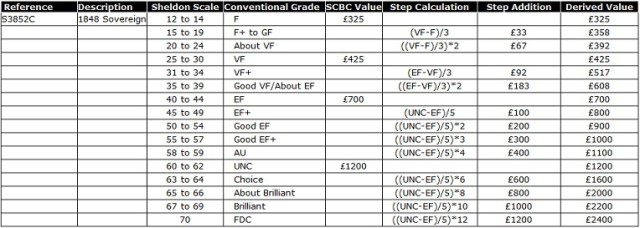
You can make similar tables for any coin listed in the SCBC by entering the values shown in the “SCBC Value” column, performing the calculations in the “Step Calculation” column, and entering the results in the “Step Addition” and “Derived Value” columns. If you have the calculations set up in a spreadsheet, it’s as simple as replacing the numbers in the “SCBC Values” column.

There are a few limitations to this approach:

  1. The SCBC typically does not provide values for coins in FDC condition, so step calculations above UNC have to be based on further increases to the EF-to-UNC interval. In the above example, I assumed a coin in FDC condition to have double the value of UNC condition. In practice, this assumption is probably unrealistic – an extremely rare coin in top condition can be almost priceless! When examining very high grade coins, both this approach and the SCBC values themselves will need considerable adjustment based on experience and the coin being considered.
  2. In some cases the SCBC does not provide values for a given condition; for example, no values above VF are provided for any hammered coin. In these instances, you may have to base further increases on the F-to-VF interval. With regards to many of the hammered and ancient coins, there are so few examples in EF and higher that it would be very difficult to give a value; this could also apply to the very top grades of any other type.
  3. Finally, the SCBC provides no values at all for coins below F condition. I guess they figure the coin’s value is either its bullion value or completely subjective.

I have been using this approach for quite some time and while it isn’t perfect, it at least provides a rough guide (just like the SCBC) that is of use in determining the relative value of middle grade and common coins. As a check of its validity, it is worthwhile to see if you can find realized prices of similar coins from recent auctions. They do not have to be in the same condition. Compare the realized price against the determined value in your table, keeping in mind that realized prices often vary due to changing conditions as mentioned previously.

My thanks to Mr. Jon Blyth for his review of and comments on this article.

Posted in Books, Coins | Tagged , , , , , , , | Comments Off on Using the 2012 Standard Catalogue of British Coins

Hutsell’s Civil War Strategy gets a makeover

Background

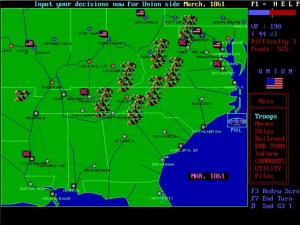
W.R. Hutsell’s VGA Civil War Strategy, a wonderful little MS-DOS gem, has been available as a free download for quite some time at Hutsell’s Games. The game’s no-nonsense graphics were a bit dated even when the game was first released, but completely adequate for the elegant point-to-point movement strategic wargame Mr. Hutsell laid underneath. The intuitive interface lets you jump right into and play without a lot of fuss, elaborate tutorials, or continuous references to a rulebook. Everything needed to cover the fundamentals of the American Civil War is present: armies and leaders with variable experience and supply, fortifications, rail and naval movement and naval invasions and commerce raiding. Interaction between all the game objects is well thought out; a lot of functional decomposition and design apparently took place long before coding began.
How to install and run the game with DOSBox

  1. Once you’ve downloaded the game, run the executable (.EXE file) to install the game on your c: drive at c:\vgastrat (the default).
  2. You’ll need DOSBox to run the game, an x86 emulator available for download here. Once you’ve downloaded DOSBox, simply run the installer.
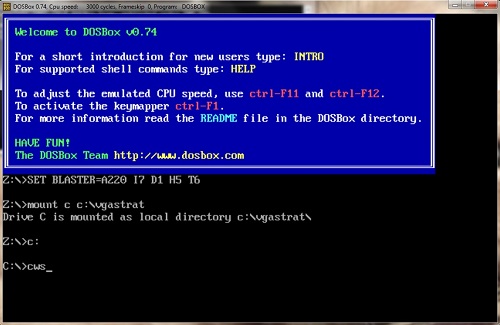
  3. Launch DOSBox, and at the DOS prompt, type mount c c:\vgastrat and press enter.
  4. Type c:\ at the next prompt and press enter.
  5. Type cws at the next prompt to run the game. Here’s a screenshot of these last three steps:

What’s coming in the future

This is already great gaming as it stands, but that’s just for starters. Dave Mackey, who runs the Hutsell’s Games website, has been hard at work porting this gem from MS-DOS so it can run without DOSBox, and released beta version 1.58 on December 17, available for download here. Beyond the beta limitations he notes in advance, it looks and plays just like the original. With the DOSBox hamstring out of the way, he will be free not only to add the graphics bells and whistles gamers have come to expect, but possibly to add in subroutines allowing players to fight out the battles the game currently resolves on its own using troop strengths, levels of experience and fortification, leadership, etc. Beyond that, he potentially could apply the game engine to similar conflicts. The Second Anglo-Boer War comes immediately to my mind, since it took place in roughly the same technological environment.

A clean interface and coherent design are things you just don’t see much of these days. Some developers release strategic and operational level games in an almost unplayable state with inadequate documentation. It’s an irritating paradox — players are left reading forum posts trying to identify fundamental relationships between game objects that should have defined as part of the design process, but instead are changed in subsequent releases.

Hat tip to Mr. Mackey for quite a positive development to keep an eye on over the coming year. His effort polishing up this gem is sure to bear fruit.

Posted in Games | Tagged , , , , , | 8 Comments

The 2011 White House Political Ornament

A few weeks ago, I was walking through a local stationery shop and noticed the 2011 White House Christmas ornaments. They have been available for purchase since April, and it surely took months before that to design and produce them.

This year’s ornament theme is “The Theodore Roosevelt Administration 1901–1909.” Here is a brief passage from the historical essay that accompanies the ornament:

Roosevelt epitomized a new breed of politician and from what he famously called the “bully pulpit,” he championed a federal government strong enough to restrain the power of great personal and corporate wealth and preached a “Square Deal” that would ensure every American’s right to a living wage. … In 1912 he lost a bid for re-election to the presidency on a progressive Bull Moose ticket.1

Back in April, a Christmas ornament with notes reminiscing fondly about Teddy Roosevelt and his 1912 reelection platform seemed pretty banal, but events of the past two weeks have revealed its significance: President Obama’s 2012 reelection campaign, as evidenced in his recent speech at Osawatomie, Kansas, explicitly hearkens back to the “Square Deal” populism advocated in Teddy Roosevelt’s Bull Moose ticket of 100 years ago. Neil Munro detailed President Obama’s version in a December 4 article for the Daily Caller:

The speech is to be delivered in Osawatomie, Kansas, because “just over one hundred years ago, President Teddy Roosevelt came to Osawatomie, Kansas and called for a New Nationalism, where everyone gets a fair chance, a square deal, and an equal opportunity to succeed,” said a Sunday White House press statement.2

In this context, the 2011 White House Christmas Ornament has departed from previous ornaments that simply recalled White House Christmas celebrations over the years. This year it has become a vehicle for the distribution what is essentially President Obama’s 2012 reelection campaign platform.

By its own lights, the White House Historical Association is “a charitable nonprofit institution whose purpose is to enhance the understanding, appreciation and enjoyment of the White House.”3 I find it very unethical for a nonprofit organization to use its funds and resources to produce and distribute political campaign material. I guess you can’t even buy a Christmas ornament without making a campaign contribution.

Notes:

  1. “2011 WHITE HOUSE CHRISTMAS ORNAMENT HISTORICAL ESSAY,”   http://www.whitehousehistory.org/whha_ornament/ornament_historical-essay-2011.html
  2. Neil Munro, Daily Caller, 12/4/2011, “Obama rolls out new 2012 theme,” http://dailycaller.com/2011/12/04/obama-rolls-out-new-2012-theme/
  3. White House Historical Association: “About Us,” http://www.whitehousehistory.org/whha_about/about.html
Posted in News | Tagged , | Comments Off on The 2011 White House Political Ornament

Weekend Update

Website Stuff

It’s been a week since Cox shut down my old website right on schedule. I have been so busy moving stuff that there’s been no time to post. I did manage to move the basic pages that I use the most: my start page, links, etc.

One of my first priorities was reestablishing the page for the The Young Victoria Collection, since I gave a presentation about the collection to a local coin club and their website had a link to its previous location. But when I provided the updated link to the club webmaster, he asked if I would remove any reference to myself or the rest of the website from it! Without thinking, I obligingly spent a couple of hours screwing around trying to figure out how to strip the header and take out any links to the rest of the website before stopping to ask myself — in what universe is someone linking to another website entitled to edit its content? What nonsense — take it or leave it.

Going to the Range

Sunday I did something out of the ordinary — I dragged out three of my pistols and went to a nearby indoor range for a little target practice. The three pistols were a 9mm Glock 19, a Colt .45 automatic, and a Smith & Wesson .357 magnum  revolver. As much as I like the heritage of the Colt and the dominating appearance and report of the S&W, the little Glock is far and away the superior self-defense weapon.
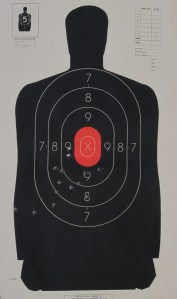
Right out the box I scored 14 out of 14 silhouette hits at 25 yards with the Glock. (Two magazines; I loaded each with only 7 rounds so I could haul the target back after each to see how I was doing.) A little low and to the left, but a nice tight shot group — not bad considering I had not fired a round in over 10 years.

The Glock 19 is an intuitive point-and-shoot pistol, so you don’t need to spend a lot of time at the range, but at only 25¢ per round, you won’t break the bank if you do. (For comparison, .45 ACP is 38¢ per round; .357 magnum is a whopping 70¢!) But don’t take my word for it; here is a  review (admittedly biased) I tend to agree with!

I’m going to have to go to the range more often…

Posted in Guns, Update | Comments Off on Weekend Update

Getting started…

On November 1 I received this tidy item from Cox Communications, my current ISP:

Dear Valued Customer,

Effective December 6, 2011, Cox will no longer offer Personal WebSpace service. We are taking this step because there has been minimal use of the service. We’d like to make sure we help you transition your Personal WebSpace files and content as smoothly as possible.

Pretty nice, eh? Effectively one month’s notice to every customer that Cox was pulling the rug out from under them. The only “help” provided was a link to a web hosting service, something anyone could have gotten from a web search, except Cox may have gotten a kickback for providing that particular one.

In compensation, Cox now offers 50GB online backup which, to the average user with a 1TB+ hard drive, is like offering a teaspoon to bail out an ocean liner.

So over the next month or so I’ll be transitioning my website content here, learning the WordPress idiocyncracies along the way. To make lemonade from this lemon, I figure I’ll be able to offer more dynamic content and be better positioned for the next lemon to arrive…

Posted in Update | Comments Off on Getting started…