Twist and Shout

As anticipated, the Fed today announced plans to burn $40 billion a month, with no end in sight:

The Fed said it will buy $40 billion of mortgage-backed securities per month in an attempt to foster a nascent recovery in the real estate market.

The purchases will be open-ended, meaning that they will continue until the Fed is satisfied that economic conditions, primarily in unemployment, improve. …

Enacting the third leg of quantitative easing, or QE3, will take the Fed’s money creation past the $3 trillion level since it began the process in 2008. …

In addition, the Fed said it will continue its program of selling shorter-dated government debt and buying longer-term securities, a mechanism known as Operation Twist. …

The stock market, which had been slightly positive prior to the decision, shortly after 12:30 p.m., surged while bond yields, particularly farther out on the curve, jumped higher. Gold and other metals gained at least 1 percent across the board while the dollar slid against most global currencies.

— Jeff Cox, “Fed Pulls Trigger, to Buy Mortgages in Effort to Lower Rates,” CNBC, 9/13/2012 | http://tinyurl.com/8rqloa5

Well, this was rather predictable. I’ll leave forming a mental image of “open ended” to you, but since the Fed is starting QE3 with Operation Twist still playing in the background, I think “Twist and Shout,” gives only a faint prospect we can “work it all out.” You’d think it was an election year or something.

Anyway, gold prices went up as expected. But what’s this tepid statement from CNBC about gold gaining “at least one percent?” It went up almost another $40 per ounce, in a repeat of Friday’s jump! Good grief, I could just about use the chart I used for Friday’s post today, and you’d hardly be able to tell! But here is today’s gold chart, from APMEX:

Gold and silver climbed to six-month high as the Federal Reserve’s announced round of bond buying sparked a retreat in the U.S. dollar and demand for a hedge against potential inflation down the line.

The most actively traded gold contract, for December delivery, rose $38.40, or 2.2%, to settle at $1,772.10 a troy ounce on the Comex division of the New York Mercantile Exchange, the highest settlement since Feb. 28.

Silver rose 4.5% to settle at $34.778 a troy ounce, the highest since March 1. …

The Fed’s action was widely expected after Fed Chairman Ben Bernanke and other officials hinted at the central bank’s willingness to act should economic growth in the U.S. weaken. Gold futures gained 9% between Aug. 2 and Wednesday’s close.

Even after those gains, “I think that you had a lot of people sitting on the sidelines just wanting to make sure there wasn’t a surprise here” on Thursday, said Matt Zeman, head of trading with Kingsview Financial.

Thursday’s gains could spark another leg higher in gold in the weeks ahead, said Adam Klopfenstein, a senior market strategist with Archer Financial Services.

Gold spent much of this summer in sideways trading, as investors worried about the global economy preferred the U.S. dollar at the expense of precious metals. That sparked some talk that gold’s 11-year bull run could be set to stumble, and speculators grew cautious toward the metal.

After the Fed’s announcements, “I think we’re going to see a lot of the [gold] skeptics throwing in the towel,” Mr. Klopfenstein said, adding that some of those traders were closing out bets on lower prices on Thursday. “Gold is having an impressive run.”

— Matt Day and Nicole Friedman, “Gold, Silver Surge on Fed Plans,” Wall Street Journal, 09/13/2012 | http://tinyurl.com/937aa7b

So where do we go from here? It’s pretty early for a consensus from precious metals analysts, but Kitco’s Jim Wycoff had this to say:

Technically, December gold futures prices closed near the session high Thursday, hit another fresh six-month high and scored a big and bullish “outside day” up on the daily bar chart—whereby the high was higher and low was lower than the previous session’s trading range, with a higher close. Bulls gained solid upside technical power Thursday to now suggest a challenge of the 2012 high of $1,800.90, or above.

— Jim Wycoff, “PM Kitco Metals Roundup: Comex Gold Powers to 6-Mo. High on QE3 from U.S. Federal Reserve,” Kitco, 09/13/2012, http://tinyurl.com/9hrbpez

That’s probably a conservative position. On Friday, some analysts were suggesting a 2012 high of $2,000 or more, and that was before the “open-ended” characterization was announced. With the Fed burning through $40 billion a month, no US government action in sight on the looming fiscal cliff, and turmoil from US elections and global unrest/terrorism, I’d say gold at $2,000 plus by year’s end is a pretty reasonable bet.

Posted in News | Tagged , , , | Comments Off on Twist and Shout

They Were Expensable

One of the many less-fun things about being an employee of a defense contractor is the constant reminder that you are expensable. You and your salary and benefits are an operating expense, one of the items on the accounts payable side of the company’s financial balance sheet that is hopefully balanced by an item on the accounts receivable side under a government contract. If it isn’t, you’re just a drain on the company’s bottom line. Unless the government signs a new or renewed contract, it’s only a matter of time before the company sends you a pink slip.

Enter the WARN Act of 1988, which requires companies to notify employees at least 60 days in advance if the contract they’re working on is expected to expire. A lame idea, actually, because it pushes the ugliness of layoff notices onto the companies, when it is the government’s indecisiveness on whether to renew defense contracts that is the source of the problem. But at least it gives the hapless defense consultant 60 days to figure out where the next mortgage payment will come from.

That’s why you have to love this latest twist: Unless Congress and the President acts, a $110 billion budget cut, half coming from defense, will automatically take place on January 2, 2013. This cannot help but cause contract terminations and resultant layoffs. Of course, none of the politicians want to do anything about the budget before the election, and the White House certainly doesn’t want all those pink slips going out in the mail on Election Day!

What to do? Have the Labor Department announce that the WARN Act magically doesn’t apply!

White House to defense contractors: Don’t warn employees before election they may get laid off

Obama’s Labor Department is trying to spare the president the embarrassment of having hundreds of thousands of layoff notices arrive in the mail just before Election Day, including in the crucial swing state of Virginia. It issued a guidance [link to pdf] yesterday to defense contractors that just happened to advise them not to send federally-required warnings to their employees that they could get pink slipped because Washington can’t get the budget under control.

— Sean Higgins, Washington Examiner, 07/31/2012 | http://tinyurl.com/cvvqruk

So, if you’re a defense consultant, put on a happy face, pay no attention to that man behind the curtain while casting your ballot, and good luck coming up with that mortgage payment next year!

Posted in News | Tagged , , , , , | Comments Off on They Were Expensable

Transitions

Design Changes to the Young Head Victoria Shield Sovereign, 1838 – 1887

1. Introduction

One of the challenges confronting the collector of young head Victoria shield sovereigns is the lack of an overview of the transitions between design changes during the period. Because obverse and reverse changes were sometimes not concurrent, it is easy for confusion to arise. Most sources assume some advance reader familiarity. Some distinguish only between die and non-die numbered issues when assigning reference numbers and provide limited notes to guide the reader through transitions. Others provide more detailed reference numbers but the transitions between changes can still be difficult to follow. This article presents a summary of the transitions to clarify their sequence and relationships.

2. Scope

The discussion below is limited to major design changes made to young head Victoria shield sovereigns from 1838 to 1887. Errors, proofs, and minor variances in hair arrangement are not discussed unless they are pertinent to overall design change. Principal references cited are Marsh, The Gold Sovereign, and Spink, Coins of England and the United Kingdom, noted below.

3. Discussion

a. The first major transition was the change from the first group Marsh describes, which Spink refers to as the first young head (S.3852 and 3852A and B), to the second group (Spink’s second young head; S.3852C). This second group was introduced in 1848. Both the first and second young head designs were produced that year, after which the first young head was discontinued. The obverse of the second young head design featured a larger head, resulting in a decreased distance between the bust and the legend lettering. The reverse design elements were rearranged on the second young head design, so that the end characters of the legend letters and the leaf tips below them were no longer vertically aligned. Figure A shows the changes to design elements.

b. Before continuing the description of transitions, it is worth turning aside for a moment to address the two first young head “narrow shield” variants that appeared only in 1838 and 1843 (S.3852A and B). These variants featured a reverse possibly engraved by Jean Baptiste Merlen. Figure B shows the reverses of the two narrow shield variants compared to the reverse of an 1839 sovereign to highlight the identifying characteristics.

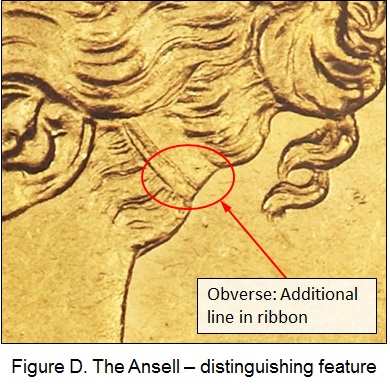
c. For the two subsequent transitions, we will first examine obverse changes and return to reverse changes below. In the transition of 1853, two significant obverse design changes took place from the second young head described above (S.3852C) to the rest of the S.3852 series (D through F) and S.3853. Both S.3852C and 3852D were produced during 1853 through 1855. Marsh considers these changes significant enough to be considered a third group, while Spink treats them merely as variations on the second young head design. On the obverse, the “W.W.” relief on the bust truncation (for William Wyon, the Chief Engraver from 1828-1851) was changed to “WW” incuse, and the ribbon at the nape of the neck was changed from a narrow to a broader design, with pronounced edge lines. This changed obverse remained in production until 1870. Figure C shows the transitions described that took place in 1853 and those that took place in 1870, described below. There were two notable variants during this period. The first, the Ansell, appeared only in 1859 and featured an additional raised line on the lower part of the ribbon. It was a well-documented experiment in the use of brittle gold by Royal Mint chemist George Frederick Ansell, for whom it is named. Figure D shows the additional line on the neck ribbon that is the Ansell’s distinguishing feature. The second variant, the 827 sovereign of 1863 (S.3852E and F), we will return to below.

d. In the transition of 1870, the “W.W.” relief and narrow ribbon used before 1853 were reintroduced. Marsh describes this as a revision back to the second group (second young head; S.3852C). Spink describes this as the introduction of a third young head design (S.3853B). The 1872 sovereign without a die number, previously catalogued as S.3852C, clearly belongs with this later group. As noted, Figure C shows the transitions that took place in 1870.

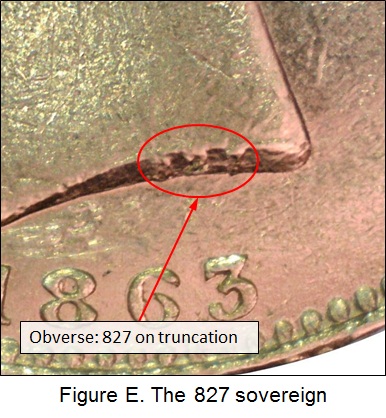
e. Returning to the 827 sovereign, it is fairly well established that the 827 on the obverse truncation was associated with a specific ingot that, like the gold from which the Ansell sovereign was made, was at first thought to be unusable. Records show that refiners Rothschild’s and Brown & Wingrove conducted further processing on two 200-ounce ingots (numbered 816 and 830) for the Mint, so it is thought that the initial batch of 827 sovereigns with no die number (S.3852F) were made from a similar ingot and proved to be acceptable for circulation. The subsequent 827 sovereigns with die number 22 on the reverse (S.3853A) were evidently made from the melted scrap and “scissel” (cuttings) left over from making the initial batch. Because of this, it is probable that all of the non-die numbered 827 sovereigns were produced and the results evaluated before full rate production of die numbered sovereigns began in 1863 (S.3853). Figure E shows the 827 on truncation that distinguishes the variant.

f. The discussion of the 827 sovereign leads us naturally to the design changes to the reverse, which after 1848 did not take place in conjunction with changes to the obverse. Throughout the period from 1848 to 1863, the reverse design remained unchanged. In 1863, die numbers were introduced to the reverse in the space below the wreath and above the floral emblem. Die characters “M” and “S” were later associated with the Australian mints at Melbourne and Sydney. Die numbers enabled production to be pinpointed to a specific coin press and operator as a means of quality control, and recorded errors fell dramatically after 1863.

g. Production of shield sovereigns in London ended after 1874, but continued in Australia. Shield sovereigns first entered production in Australia at Sydney in 1871, during which time both the “WW” incuse and “W.W.” relief varieties were produced. Production of the “WW” incuse variety ended after 1871 and production of the “W.W.” relief variety continued at both Melbourne and Sydney until 1887.

4. Summary

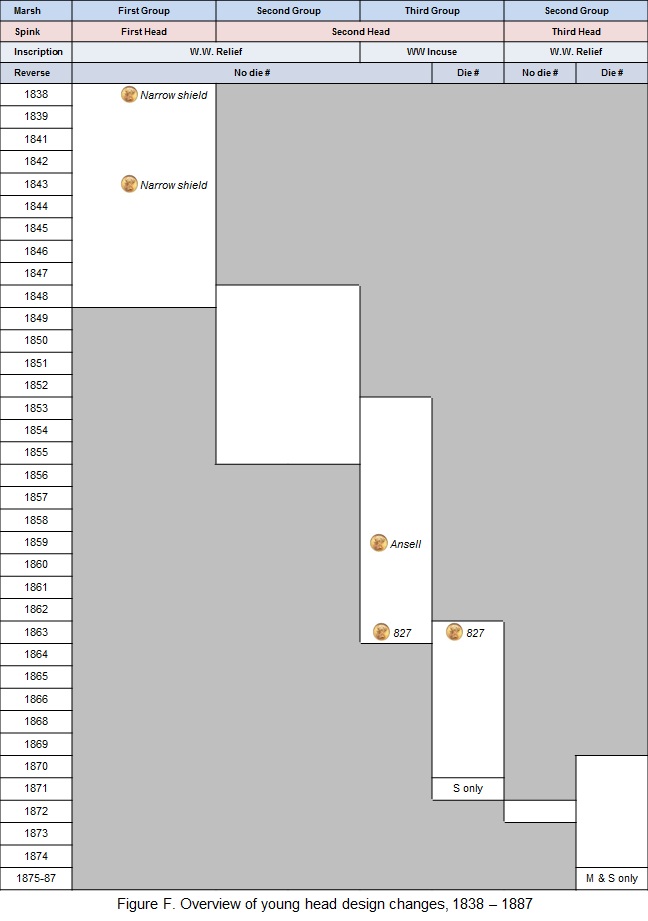
Figure F presents a graphical overview of the design transitions discussed. The two top rows present columns that divide sovereign production into the groups described by Marsh and head designs described by Spink. The next two rows present columns to indicate the characterization of the truncation inscription (incuse or relief) and the presence of die numbers on the reverse. White boxes in rows below indicate production of the design described. The figure illustrates the transitions from the first group/first young head to the second group/second young head in 1848, from W.W. relief to WW incuse in 1853, and from WW incuse back to W.W. relief in 1870. The die numbers introduced in 1863 can be seen as independent of these major transitions.

Image Sources

  • Victoria gold Sovereign 1838 Young Head, “narrow shield” variety, S.3852A, KM736.1, Extremely Fine. Lot 38, Baldwin’s Auctions Ltd, Auction 73, 8 May 2012, http://tinyurl.com/cwjkyp2, accessed June 25, 2012.
  • Victoria gold Sovereign 1839, Young Head, Shield reverse, S.3852, KM736.1, MS64 PCGS. Lot 24993, Heritage 2011 September Long Beach Signature World & Ancient Coins Auction #3015, http://tinyurl.com/d7gxxrg, accessed 24 May 2012.
  • Victoria gold Sovereign 1843 Young Head, “narrow shield” variety, S.3852B, KM736.1, Extremely Fine. Lot 45, Baldwin’s Auctions Ltd, Auction 73, 8 May 2012, http://tinyurl.com/boz8cpd, accessed June 25, 2012.
  • Victoria gold Sovereign 1852, Young Head, Shield reverse, S.3852C, KM736.1, MS64 Terner PCGS. Lot 24997, Heritage 2011 September Long Beach Signature World & Ancient Coins Auction #3015, http://tinyurl.com/budtdey, accessed 24 May 2012.
  • Victoria gold “Ansell” Sovereign 1859, Young Head, Shield reverse, S.3852E, KM763.3, AU55 PCGS. Lot 24235, Heritage 2011 January New York Signature World & Ancient Coins Auction #3012, http://tinyurl.com/ctolsq3, accessed 25 June 2012.
  • Victoria Sovereign 1862, Young Head, Shield reverse, incuse WW, wide date, normal legends, S.3852D, KM736.1, MS64 Terner PCGS. Lot 24429, Heritage 2012 January 2-3 World & Ancient Coins Signature Auction- New York #3016, http://tinyurl.com/d3tzwup, accessed 23 May 2012.
  • Victoria gold Sovereign, 1863, Young Head, Shield reverse, numbers 827 in relief on truncation, Die #22, S.3852F, KM736.2, Extremely Fine. Lot 106, Baldwin’s Auctions Ltd, Auction 73, 8 May 2012, author’s photo.
  • Victoria gold Sovereign 1872, Young Head, Shield reverse, Die #108, S.3853B, KM736.2, MS63 NGC. Lot 24759, Heritage 2012 April 25-May 1 World & Ancient Coins CICF Signature Auction- Chicago #3019, http://tinyurl.com/bsu3a8l, accessed 23 May 2012.

References

  • Steve Hill, “Baldwin’s Auction 73: The Bentley Collection, British Milled Sovereigns, Part I.” London: A H Baldwin and Sons Ltd, 8 May 2012.
  • Michael A. Marsh, The Gold Sovereign. Cambridge: Cambridge University Press; Golden Jubilee Edition, 2002. (Note: Marsh’s discussion of the three young head design groups can be found on pages 29-30, and is illustrated on Plate 22.)
  • Thomas Michael, Standard Catalog of World Coins, 1801-1900. Iola, WI: Krause Publications, 6th edition, 2009. (Note: Reference numbers assigned to non-die and die numbered issues and the Ansell variant only [KM# 736.1, 736.2, and 736.3, respectively.])
  • Philip Skingley, Coins of England and the United Kingdom: Standard Catalogue of British Coins. London: Spink & Son, 47th revised edition, 1 December 2011. (Note: Spink reference numbers used throughout. The characterization of S.3853B as a third young head design does not appear in the 47th edition. It is anticipated in a future edition based upon observations presented by Steve Hill in the Bentley Collection catalogue noted above.

September-TransitionsThis article appeared in the September 2013 issue of Coin News.

Posted in Coins | Tagged , , , , , , , , , | 2 Comments

Busy Morning

An egret and a beaver making their morning rounds at Huntley Meadows Park, Virginia.

img_2924

Posted in Photography | Tagged , , , , | Comments Off on Busy Morning

The value of a cent

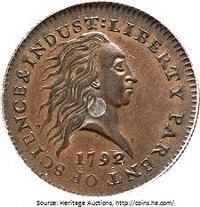
I just read news that a 1792 US silver center cent sold for $1 million at a recent Heritage auction!* A pattern with a known population of less than a couple dozen, it’s one of the most extreme example of the relative impossibility of estimating coin values I’ve ever seen.

It’s an ugly coin, to be sure. The Leopold Taler I wrote about some time ago is also quite ugly, but it at least presents what we believe is a fairly accurate portrait of a real historical figure, and was a forerunner to the silver crown/trade dollar that was widely imitated and used for trade around the world.

The silver center cent, on the other hand, presents a conceptual figure, Lady Liberty, so poorly executed that she resembles a hairy troll. (But perhaps not far from Delacroix’s portrayal, come to think of it.) It never entered production and was never used in commerce or in any other capacity. Nevertheless, the cataloguer described it as being “…the single most significant and historically important coin ever produced at the Philadelphia Mint!” Its rarity alone apparently drives the price; otherwise, I have no idea how anyone could arrive at a value of $1 million for this cent.

Some time ago I wrote a post about interpolating coin values found in the Spink Catalog of British Coins (SCBC). Aside from the acknowledgement that estimates fall apart at the extremes, a couple of going in assumptions probably weren’t clearly stated:

    • An agreed-upon correlation between traditional grading values (e.g., F, VF, EF/XF, etc.) and the Sheldon Scale (0 to 70, where 12-14 = F, 25-30=VF, 40-44=EF, etc.) in the coin collection community. This isn’t always the case; since posting I’ve heard at least one opinion that truly uncirculated doesn’t begin until somewhere around MS 64. More on this another time.
    • Other than a note that other values exist, an implied acceptance of the values for each grade found in the 2012 SCBC. This was assumed just to get on with the business of providing a construct for interpolating between values for each grade, regardless of whether you consider the values to be valid.

The latter assumption is something of a problem: Even if you agree on the relative condition of a coin, there no consensus on the value whatsoever! Here’s an example, looking at the book values found in Krause, Coin World, and SCBC for an 1845 Sovereign in Extremely Fine Condition:

Good grief, the high value, $1309, is over three times the low value! There’s almost no point to having price guides, is there?

I guess they are of some use, though. If you’re a buyer, you can plan on paying closer to the high value; maybe even a little higher if it’s a rarity and/or if it’s at auction and the bidding is sharp. If you’re a seller, you have to be aware that in an auction, you may wind up with the low value, or even less if no one is paying any attention.

Even at $1309, I’d prefer the lovely 1845 Sovereign over the silver center cent any day. I guess the great thing about coin collecting is that everyone has their own tastes, so there’s room in the hobby for everyone. Even for those who don’t have $1 million to spare…

* Eric Pfeiffer, Yahoo! News Sideshow, April 20, 2012 |  http://tinyurl.com/7xz4s5s 

Posted in Coins, News | Tagged | Comments Off on The value of a cent

Cherry Blossoms 2012

 The shoreline in East Potomac Park, near East Basin Drive and the Jefferson Memorial

Because of rain and thunderstorms in the weekend forecast, on Friday I went with a small group for a short lunchtime walk around the Tidal Basin. Click the photo to view a Flickr slideshow (14 photos). Beautiful day! Weather permitting, I hope to go again this weekend and see the rest of East Potomac Park to Hains Point.

UPDATE, 3/25/2012: I went back with a larger group on Sunday and while it was overcast, the rain didn’t materialize and we were able to enjoy a pleasant 6-mile walk. I’ve added seven more photos to the Flickr slideshow.

Posted in Events, Hiking, Photography | Comments Off on Cherry Blossoms 2012

Back on the Trail

With spring arriving, it’s time to get back on the walking trail! I have been a member of a local walking and hiking group for several years, always just tagging along enjoying the scenery and taking photos. But in January I started organizing events, and there’s a couple of nice ones lined up to take advantage of the mild weather!

This coming Sunday we’re going for a 4-mile walk along the Mount Vernon Trail, taking in views of Dyke Marsh Nature Preserve and the Potomac River. The weather forecast is partly sunny and 70 degrees, so it sounds like it will be a perfect outing!

The next weekend we’re going for a 6-mile walk around the Tidal Basin and East Potomac Park in Washington, DC, on the opening day of the National Cherry Blossom Festival. The festival is a pretty big deal every spring in DC, and this year is extra special because it’s the centennial event – over 3,000 cherry trees donated by Japan arrived in Washington 100 years ago! In addition to the seeing cherry blossoms, the walk will take us past quite a few of the sights around the Tidal Basin – the Jefferson, George Mason, FDR, and Martin Luther King memorials, to name a few. It’s kind of chancy going on opening day, because there is sure to be large crowds and the walking group may tend to get separated. On the other hand, if there is inclement weather, we can slip to the next weekend without missing the blooming season. Last year we went at the end of the Festival and while it was a great walk, it was overcast and cut short by thunderstorms, so photo opportunities were limited.

Posted in Events, Hiking, Photography | Tagged | Comments Off on Back on the Trail

Daffodils

These daffodils bloomed just in time for St. David’s Day.

Posted in Events, Photography | Comments Off on Daffodils

Rainy Day Visitors


Two bucks?! A rainy day brings a small herd of deer to the woods outside my backyard fence. Note the construction in the background – developers are paving a cul-de-sac that will leave these woods otherwise undisturbed. Fortunate, because these woods connect to a local district park, which in turn borders on Huntley Meadows Park, a 1,425-acre wetlands nature preserve that is home to a variety of wildlife.

Posted in Photography | Tagged , , | Comments Off on Rainy Day Visitors

Evliya Çelebi and the Leopold Taler

Here’s an entertaining description of Holy Roman Emperor Leopold I; who lived from June 9, 1640 to May 5, 1705; given by Evliya Çelebi, an Ottoman traveler who visited Leopold’s court at Vienna in 1665:

One may almost doubt whether the Almighty really intended, in him, to create a man …

He is a young man of medium height, beardless, narrow-hipped, not really fat and corpulent, but not exactly haggard.

By God’s decision he has a bottle-shaped head, pointed at the top like the cap of a dancing dervish or like a gourd pear. His brow is flat as a board and he has thick black eyebrows, set far apart, under which his light brown eyes, round as circles and rimmed with black lashes, gleam like the orbs of a horned owl.

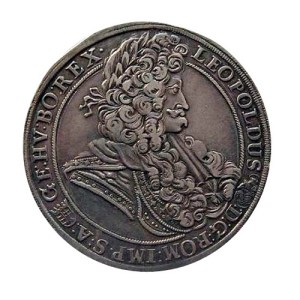
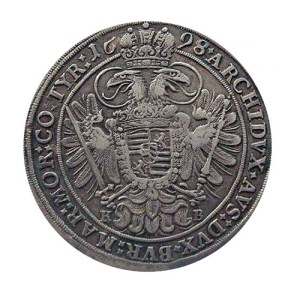
    1698 KB Hungary Taler, DAV-3264, XF 40

His face is long and sharp like a fox, with ears as big as children’s slippers, and a red nose that shines like an unripe grape and is as big as an eggplant from Morea. From his broad nostrils, into each of which he could stick three fingers at a time, droop hairs as long as moustachios of a 30-year-old swashbuckler, growing in confused tangles with the hair on his upper lip and with his black whiskers, which reach as far as his ears. His lips are swollen like a camel’s and his mouth could hold a whole loaf of bread at a time. His teeth too are as big and as white as a camel’s. Whenever he speaks, the spittle spurts and splashes over him from his mouth and camel lips, as if he had vomited. Then the dazzlingly beautiful page boys who stand by him wipe away the spittle with huge, red handkerchiefs. He himself constantly combs his locks and curls with a comb. His fingers look like cucumbers from Langa.

By the will of the Almighty God, all the emperors of this house are equally repulsive in appearance. And in all their churches and houses, as well as on their coins, the emperor is depicted with this ugly face; indeed, if any artist depicts him with a handsome face, he has that man executed, for he considers that he has disfigured him. For these emperors are proud and boastful of their ugliness.*

Princeton historian Bernard Lewis notes that Çelebi’s purpose was to entertain as much as inform. The description certainly is entertaining, although comparing the emperor’s features to various objects, animals, fruits and vegetables is also quite contemptuous. (Lese-majeste was taken more seriously back then.)

But Lewis also dismisses Çelebi’s words as “obvious caricatures.” Were they? If you look at a 1698 silver Taler like the one shown above while reading, you might conclude that Çelebi’s description, while exaggerated for entertainment value, was actually fairly accurate. Prognathism was a well-known hereditary trait of the House of Habsburg.

Regardless of Dr. Lewis’s other credentials, I guess we can assume he isn’t a coin collector!

* Bernard Lewis, The Muslim Discovery of EuropeNew York: W.W. Norton, 2001, page 113.

Posted in Books, Coins, History | Tagged , , , , | Comments Off on Evliya Çelebi and the Leopold Taler