Here’s an entertaining description of Holy Roman Emperor Leopold I; who lived from June 9, 1640 to May 5, 1705; given by Evliya Çelebi, an Ottoman traveler who visited Leopold’s court at Vienna in 1665:
One may almost doubt whether the Almighty really intended, in him, to create a man …
He is a young man of medium height, beardless, narrow-hipped, not really fat and corpulent, but not exactly haggard.
By God’s decision he has a bottle-shaped head, pointed at the top like the cap of a dancing dervish or like a gourd pear. His brow is flat as a board and he has thick black eyebrows, set far apart, under which his light brown eyes, round as circles and rimmed with black lashes, gleam like the orbs of a horned owl.
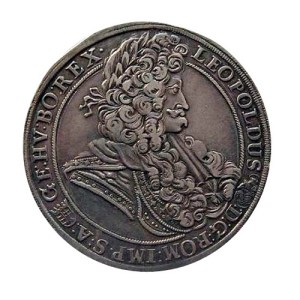
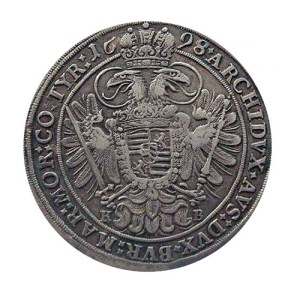 1698 KB Hungary Taler, DAV-3264, XF 40
His face is long and sharp like a fox, with ears as big as children’s slippers, and a red nose that shines like an unripe grape and is as big as an eggplant from Morea. From his broad nostrils, into each of which he could stick three fingers at a time, droop hairs as long as moustachios of a 30-year-old swashbuckler, growing in confused tangles with the hair on his upper lip and with his black whiskers, which reach as far as his ears. His lips are swollen like a camel’s and his mouth could hold a whole loaf of bread at a time. His teeth too are as big and as white as a camel’s. Whenever he speaks, the spittle spurts and splashes over him from his mouth and camel lips, as if he had vomited. Then the dazzlingly beautiful page boys who stand by him wipe away the spittle with huge, red handkerchiefs. He himself constantly combs his locks and curls with a comb. His fingers look like cucumbers from Langa.
By the will of the Almighty God, all the emperors of this house are equally repulsive in appearance. And in all their churches and houses, as well as on their coins, the emperor is depicted with this ugly face; indeed, if any artist depicts him with a handsome face, he has that man executed, for he considers that he has disfigured him. For these emperors are proud and boastful of their ugliness.*
Princeton historian Bernard Lewis notes that Çelebi’s purpose was to entertain as much as inform. The description certainly is entertaining, although comparing the emperor’s features to various objects, animals, fruits and vegetables is also quite contemptuous. (Lese-majeste was taken more seriously back then.)
But Lewis also dismisses Çelebi’s words as “obvious caricatures.” Were they? If you look at a 1698 silver Taler like the one shown above while reading, you might conclude that Çelebi’s description, while exaggerated for entertainment value, was actually fairly accurate. Prognathism was a well-known hereditary trait of the House of Habsburg.
Regardless of Dr. Lewis’s other credentials, I guess we can assume he isn’t a coin collector!
* Bernard Lewis, The Muslim Discovery of Europe, New York: W.W. Norton, 2001, page 113.



 Krahn’s history lesson was a part of an annual tradition where the Rough Rider’s flag is displayed during a ceremony at the museum. Typically, the flag is unveiled to little pomp, but Arizona’s upcoming centennial celebration changed that. This year, the Arizona Rough Riders Historical Association, a living history group, was invited to a re-enactment ceremony.
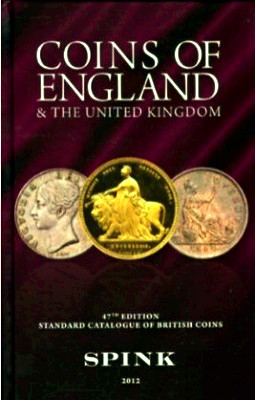
 The example table below is laid out in columns showing the SCBC reference number, a brief description, Sheldon Scale values, conventional grades, the conventional grade values from the SCBC, the calculation used to determine the amount to be added for each step above a given SCBC condition value, and the derived value once the step value is added to the value of the next lower grade. You will want to build a similar table for each coin you wish to evaluate. Setting it up in a spreadsheet will save you a lot of trouble.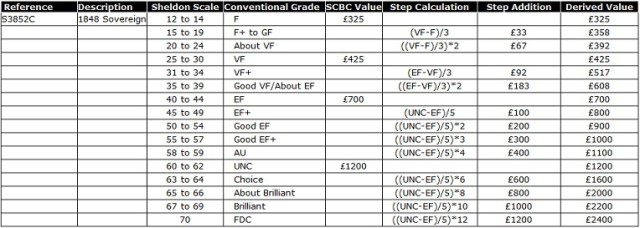

 W.R. Hutsell’s VGA Civil War Strategy, a wonderful little MS-DOS gem, has been available as a free download for quite some time at
 available for download
  A few weeks ago, I was walking through a local stationery shop and noticed the 2011 White House Christmas ornaments. They have been available for purchase since April, and it surely took months before that to design and produce them.
 Sunday I did something out of the ordinary — I dragged out three of my pistols and went to a nearby indoor range for a little target practice. The three pistols were a 9mm Glock 19, a Colt .45 automatic, and a Smith & Wesson .357 magnum revolver. As much as I like the heritage of the Colt and the dominating appearance and report of the S&W, the little Glock is far and away the superior self-defense weapon.
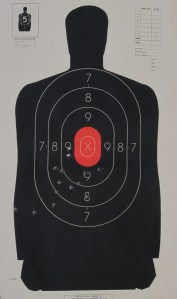 Right out the box I scored 14 out of 14 silhouette hits at 25 yards with the Glock. (Two magazines; I loaded each with only 7 rounds so I could haul the target back after each to see how I was doing.) A little low and to the left, but a nice tight shot group — not bad considering I had not fired a round in over 10 years.

